
In a smart irrigation system the decision is made in the cloud. It needs a path to the valve. A valve box has no power and no internet. So the controller uses radio instead of cable: LoRaWAN. The device that turns the radio signal into an internet connection is the gateway. The full system: system components.
What does a LoRaWAN gateway do?
The gateway works in both directions. It forwards status, battery level and flow data from the controllers to the cloud. It delivers the schedule and the AI decision from the cloud to the controllers. Every controller on site talks through one gateway.
The division of labour is simple. The controllers run on batteries and sleep most of the time. The gateway is always on; it has power and internet. Power goes to one point, not to hundreds of valve boxes.
ATL413LW gateway specifications
| Device capacity | Up to 25,000 devices |
| Internet link | 4G, Wi-Fi or Ethernet (PoE) |
| LoRaWAN | Class A/B, 8 channels; open LoRaWAN network |
| Housing | IP67 die-cast aluminium |
| Power | Mains; optional solar panel |
| Range | Up to 2 km in the city · 10 km in open terrain |
LoRaWAN is an open standard. Other LoRaWAN devices, such as water meters and sensors, can join the same network. There is no lock-in to a single vendor. Details: LoRaWAN open standard.
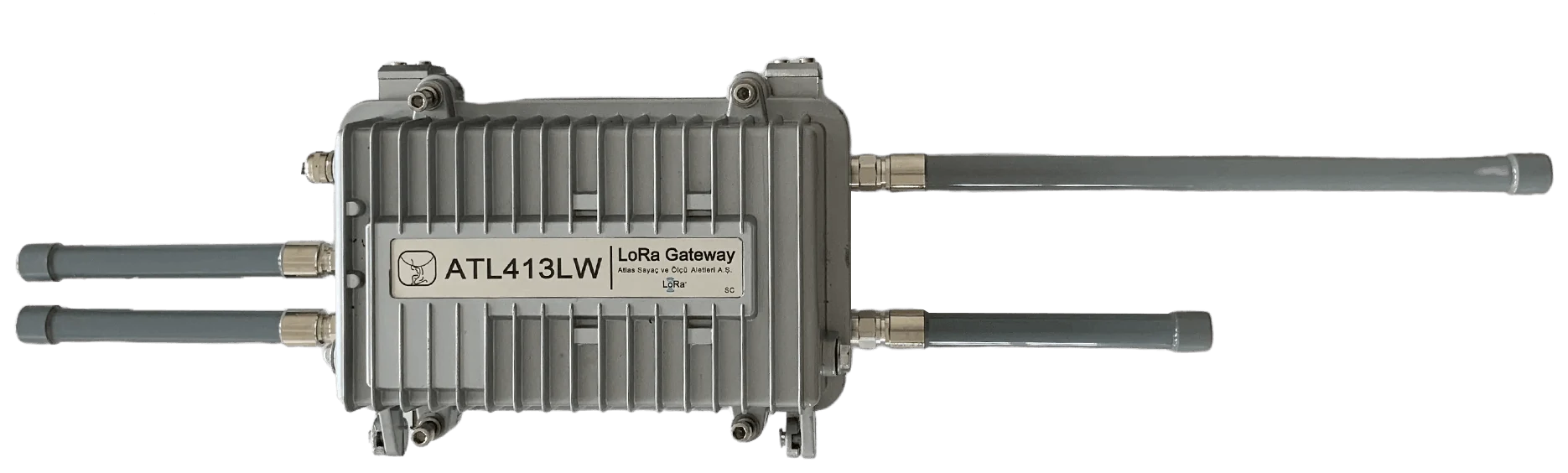
Where is the gateway placed?
Range is decided by placement. Three rules are enough.
- A high, open point. A rooftop, a lighting mast or the top of the site office works. Height extends the range.
- Line of sight to the valve boxes. Dense buildings, trees and earth fill weaken the signal. The gateway goes where it sees most of the valve boxes.
- A point with power and internet. 4G, Ethernet or Wi-Fi is connected. Where there is no power, a solar panel option exists.
Range is up to 2 km in the city and up to 10 km in open terrain. Buildings and trees shorten it. Details: how far does LoRaWAN reach?
How many gateways are needed?
One gateway is enough for most parks and estates. Even on large public gardens, one is usually used. On a boulevard that runs for kilometres, or on an obstructed site, a second gateway is added. Coverage is measured at the site survey; the number is fixed then. Details: how many gateways do I need? A site example: public garden irrigation.
A single valve outside coverage does not call for a second gateway. That valve is managed on site, from a phone over Bluetooth. Tasks are prepared in the office and delivered automatically when the technician comes into range.
Gateway installation steps
- Choosing the point. At the survey the valve boxes are mapped; the high point that sees the most boxes is chosen.
- Mounting. The gateway is fixed to a mast or a wall. The antennas are connected.
- Power and internet. Mains or solar panel; 4G, Ethernet or Wi-Fi.
- Coverage test. Signal is measured from the farthest valve boxes. A weak spot is fixed by adjusting the antenna or the location.
- Registering the controllers. Each battery valve controller registers with the panel through the gateway. From then on, schedules are sent from the office.
Installation does not change the existing irrigation infrastructure. Pipes, sprinklers and valves stay in place. ESTRON is made in Türkiye; hardware and software are developed locally.
What if the gateway or the internet goes down?
Irrigation does not stop. Each controller keeps the last schedule in its internal memory. Without a connection, the schedule runs on time. When the connection returns, the records are uploaded to the panel. Details: irrigation keeps running without internet.
Frequently asked
Where does the gateway's internet come from?
From a 4G line, Ethernet or Wi-Fi. The organisation's existing infrastructure can be used. This item is settled at the survey.
How many valves connect to one gateway?
The ATL413LW supports up to 25,000 devices. The limit is range, not capacity. On a large site a second gateway extends coverage.
Can other LoRaWAN devices use the same gateway?
Yes. LoRaWAN is an open standard. Meters and sensors join the same network. City-scale examples: park irrigation system for municipalities.