
Central irrigation control
Central irrigation control system: remote and wireless
A central irrigation control system brings every valve across scattered sites into one panel. ESTRON does it without cables. A battery controller fits the existing solenoid valve, and valves are managed from the office over LoRaWAN.
What is a central irrigation control system?
In classic irrigation, every valve group has its own timer. To change a program, crews visit each point one by one. A failed valve is noticed only when someone on site sees it.
In a central irrigation control system, all valves connect to one software. Programs are sent from the centre. Valve status, alarms and water use appear on the same screen.
Municipalities manage parks, medians and public gardens this way. Landscaping companies bring all the sites they maintain into one panel.
Three methods for central irrigation control
| Method | How it works | Limitation |
|---|---|---|
| Standalone timers | A separate controller per valve group, programmed on site | Not central; every change needs a site visit |
| Wired central system | Valves are wired to a controller, the controller joins the network | Needs cables, trenching and power; costly on spread-out sites |
| Wireless battery system (ESTRON) | A battery controller on each valve, connected to the cloud over LoRaWAN | Gateway coverage must be planned; battery level is tracked in the panel |
A wired system works well on one large site. Across hundreds of small sites spread over a city, laying cable is not practical. Wireless central control fills that gap.
How does remote irrigation control work?
ESTRON uses two channels for remote irrigation control.
- From the office, over LoRaWAN. Valves appear on a map in the web panel. One program goes to hundreds of valves at once. Open, close and delay without a site visit.
- On site, over Bluetooth. The mobile app connects within 10 m of the valve. No internet needed. Tasks prepared in the office reach valves automatically as they come into range.
If the connection drops, irrigation does not stop. The controller keeps running the program in its memory. Details: irrigation continues offline.
The software side is described on the landscape irrigation software page.
Wireless infrastructure: battery controller and LoRaWAN gateway
Fits the existing solenoid valve
The battery valve controller connects to the existing solenoid valve. Pipes, sprinklers and valve boxes stay. It works with all standard irrigation solenoids. One controller drives two solenoid valves.
It runs on 2 × 9 V batteries. No power line, cabinet or data cable. The IP67 housing withstands water and dust in the valve box.
One gateway, thousands of valves
The ATL413LW LoRaWAN gateway connects field controllers to the cloud. It supports up to 25,000 devices. Range is up to 2 km in the city and 10 km in open areas. See LoRa range.
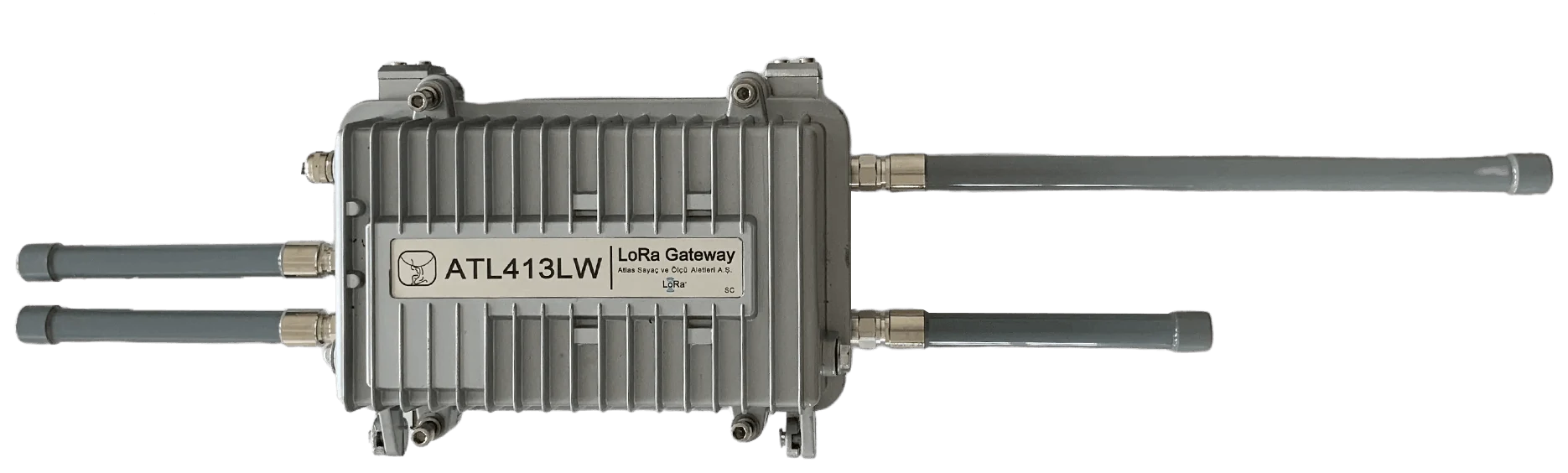
LoRaWAN is an open standard. Other devices such as meters and sensors can join the same network. See open standard.
Sensors
Rain, soil moisture, flow, pressure and temperature sensors connect to the controller. The rain sensor delays irrigation when it rains. The flow sensor catches leaks: flow while the valve is closed raises an alarm. See leak detection.
Decisions from the centre: AI
Central control is more than opening valves remotely. ESTRON decides for each irrigation line every day. Weather forecast, satellite data and soil moisture are weighed together.
If rain is expected, irrigation is delayed. If the soil is moist, it is skipped. Each decision is logged with its reason. Details: AI irrigation and smart irrigation system.
On-premise server and SCADA
The software runs in the cloud. Institutions can host it on their own server. Integration with existing SCADA systems is possible. See SCADA integration.
Permissions are role based. The department, field crews and contractors each see only their own area.
How to move to a central system
- Survey. Valve count and gateway location are set.
- Pilot site. One park or one site is chosen. Controllers are fitted to existing valves.
- Panel. Areas and water lines are entered. Programs are sent from the centre.
- Roll-out. After the pilot, other areas join the same panel.
Because the infrastructure stays, migration is fast. Cost factors are on the smart irrigation system cost page.
Battery, range and compatibility questions are on the FAQ page. City-scale examples: references.
For municipalities see park irrigation system; for maintenance firms see landscape irrigation automation. Get a quote for your project.
Get a quote for your project.
Tell us the area size and number of valves and we will get back to you.